Define filter using SQL statements
You can use ABAP Open SQL statements to filter the extracted table data.
To create ABAP Open SQL statements, you must have SQL programming skills. If the ABAP Open SQL statement is not correct, an error is displayed during the data extraction.
For details on the use of ABAP Open SQL statements, please refer to the corresponding documentation.
You can use the following ABAP Open SQL statement to filter the extracted processes. For details, see the Configure extractions chapter.
ERDAT ge '${EXTRACTION_START}' AND ERDAT le '${EXTRACTION_END}'
Note
When using dynamic parameters or other parameters of the Date data type, such as "Task start time", you can convert these parameters into any format using the format SQL function. For details on how to use the format function, see the Supported SQL functions chapter.
To edit the EBAN table, click ... Show details > Edit on the EBAN table. The Edit EBAN dialog opens.
Enter an SQL statement in the Filter statement box to define a filter.
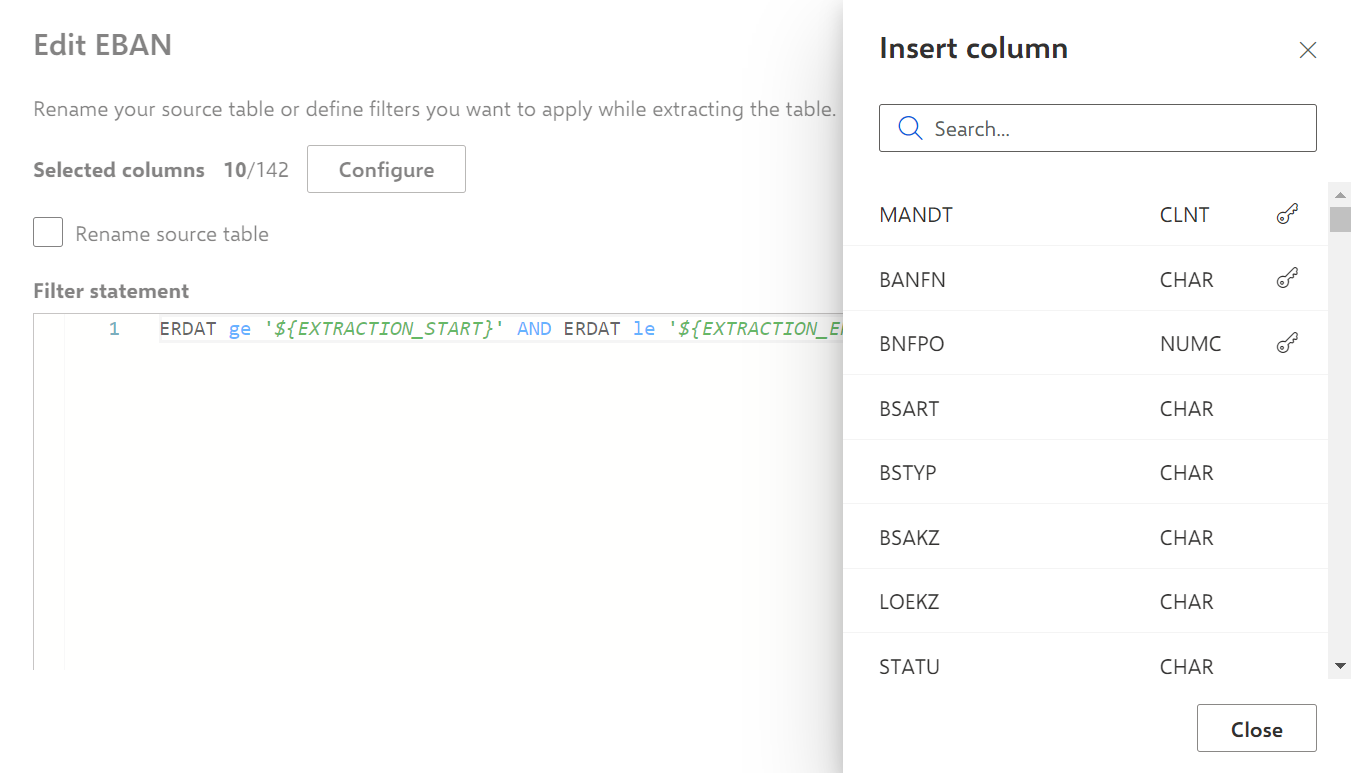
Insert the columns you want to extract. You can insert columns using the list that provides the columns you have selected in the table configuration.
Place the mouse pointer on a position in the SQL statement.
Click Insert columns and select the columns.
Click the column that you want to insert into the statement.
The selected columns are placed at the cursor position in the statement.
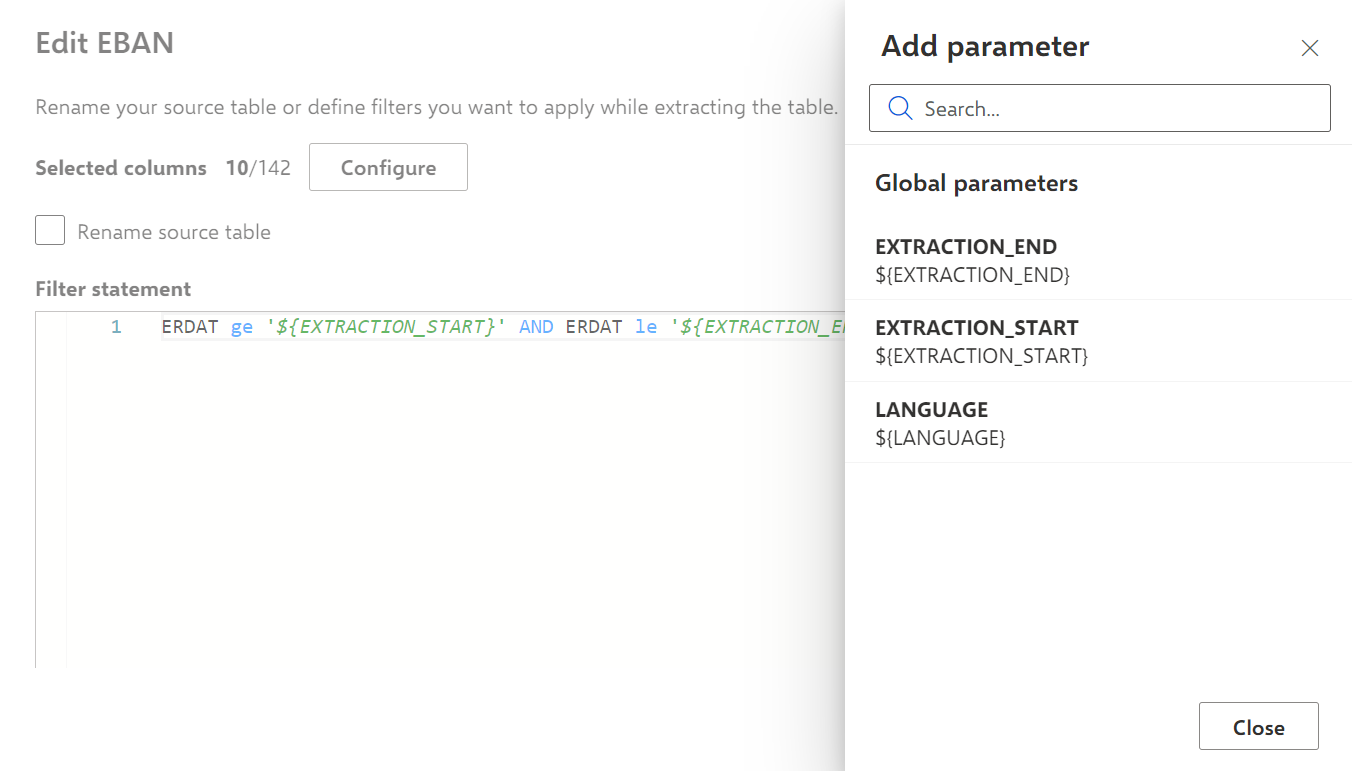
Insert parameters. You can insert parameters using the parameter list that provides the global and local parameters you have created.
Place the mouse pointer on a position in the SQL statement.
Click Insert parameter. The Add parameter dialog opens.
Click the parameter that you want to insert into the statement.
The identifier of the selected parameter is placed at the cursor position in the statement. The dialog closes automatically.
Click Done.
Your filter settings are saved.
Define filters for the MAKT table following the same configuration steps.
Tip
You can use the automatic code completion for defining a filter statement in the following ways. The code completion supports the format function.
Place the mouse pointer on a position in the SQL statement and press the Strg and 'Space' keys. A list with the format function, extraction and data set parameters, and configured columns of the source table is displayed. Select an element from the list. The element is inserted into the statement.
Place the mouse pointer on a position in the SQL statement, press 'f', select 'format', and press 'Enter'. The format function snippet is inserted and a parameter can be selected. You can now either select a parameter from the list or enter the parameter manually.
Insert a parameter into the SQL statement. Move the mouse pointer between '{' and the first letter of the parameter placeholder. Press 'f', followed by Ctrl + space. The format function is suggested. Press 'Enter' to insert the format function.